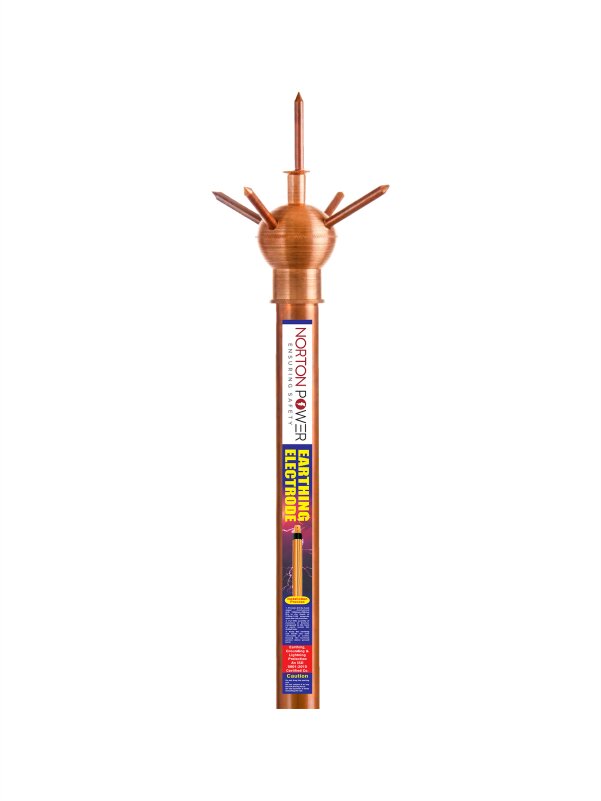
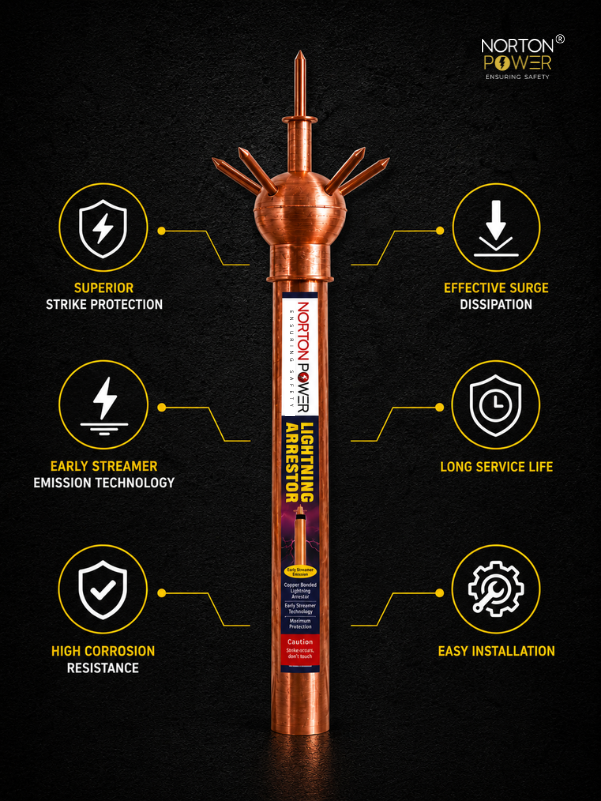
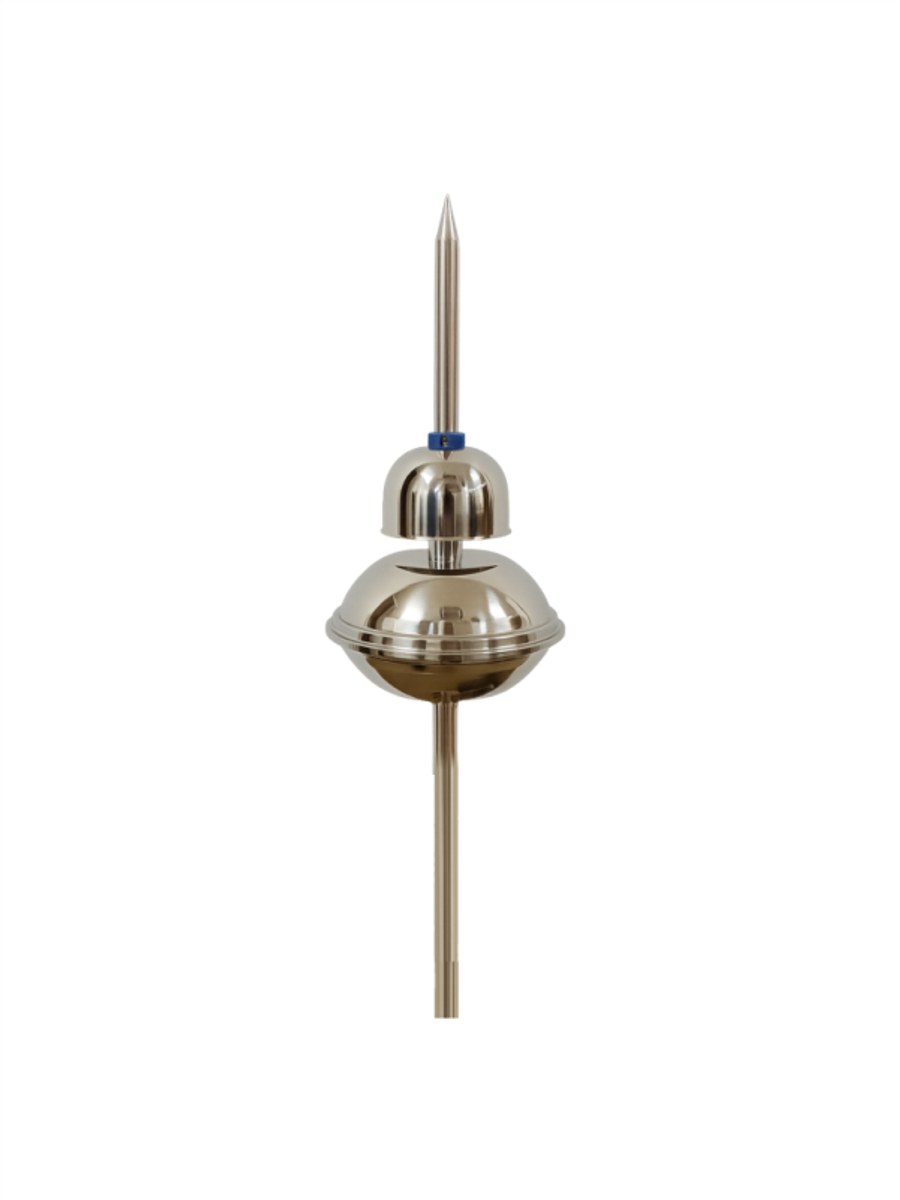
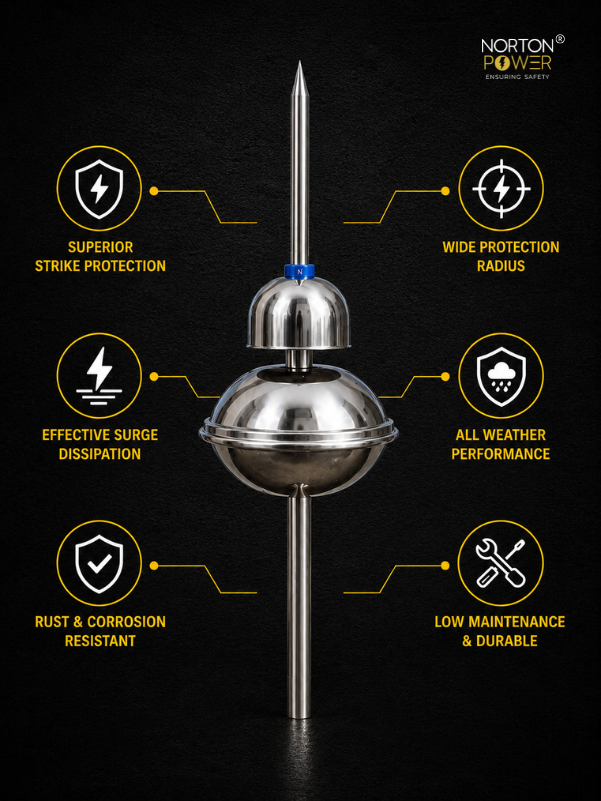
A conventional lightning arrester is the classic Franklin rod: a pointed air terminal that intercepts a strike and sends it down a conductor to earth. On larger roofs it is used with a mesh of conductors. It is the long-proven, standards-based method for most buildings and is covered by IS 2309 and IS/IEC 62305.
How it works
The rod presents the highest, earthed point so a descending strike attaches to it rather than the structure. The protected zone is worked out by the rolling-sphere or protection-angle method; bigger or taller structures need more rods or a mesh to cover the whole roof.
Conventional vs ESE
| Factor | Conventional (Franklin) vs ESE |
|---|---|
| Coverage per terminal | Smaller - may need several rods or a mesh |
| Standard | IS 2309 / IS-IEC 62305 |
| Best for | Most buildings; small to medium roofs |
| ESE advantage | Wider radius from one mast on open or large sites |