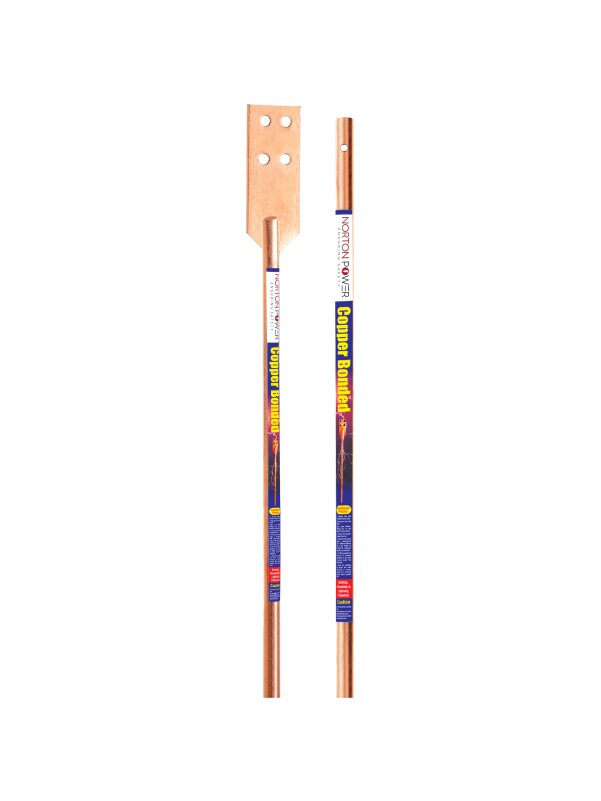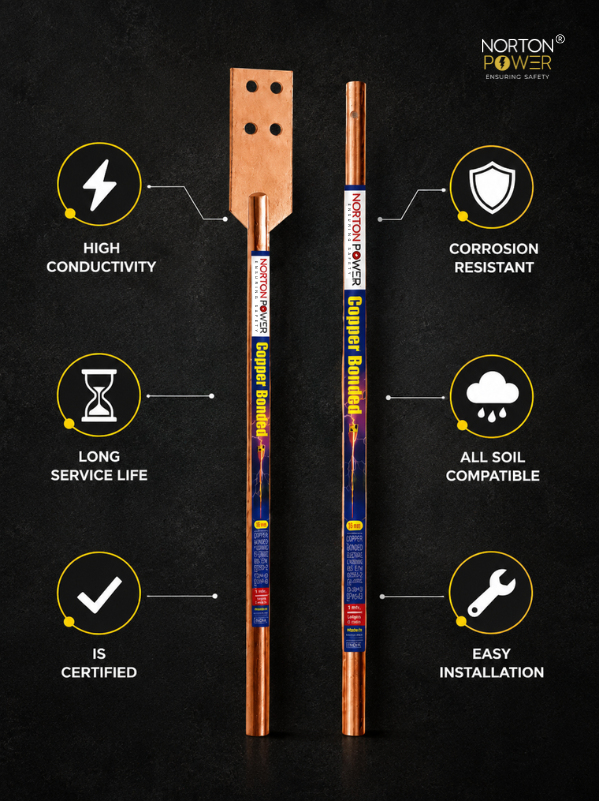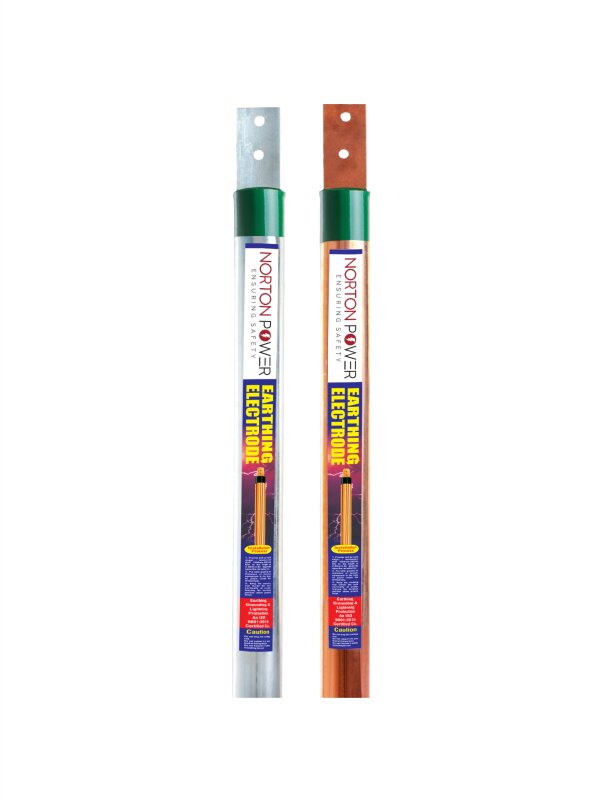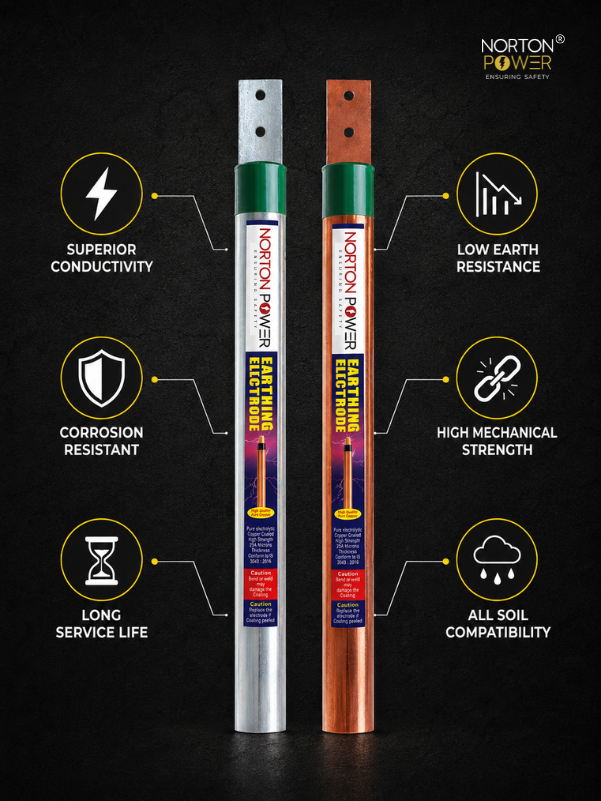
Almost every Indian B2B earthing tender boils down to a single choice: copper bonded steel or galvanised iron. The two rod families have very different lifetime profiles, standards-compliance paths, and total-installed-cost curves. This guide compares them on the dimensions that actually matter when procurement is signing off.
1. The quick answer (if you only read one section)
- Critical infrastructure (substations, solar farms, data centres, telecom towers): specify copper bonded with 250 µ coating to UL 467. Cost premium is real; lifetime payoff is bigger.
- Distribution-grade and indoor installations: GI is fine if the soil is benign and the project doesn’t need a long service life.
- Tender writes 'IS 3043 minimum': GI meets the floor; copper bonded exceeds it. Choose based on budget and exposure, not standards compliance alone.
2. Side-by-side comparison
| Attribute | Copper bonded steel · vs · Galvanised iron |
|---|---|
| Service life (Indian soil, typical) | Far longer · vs · 8–12 years |
| Coating thickness at premium tier | 250 µ Cu (UL 467) · vs · ~80 µ Zn (IS 4759) |
| Corrosion rate in moist soil | 0.5–5 µ/yr Cu · vs · 30–80 µ/yr Zn |
| Conductivity (mΩ to ground at 3 m) | lower (better) · vs · higher |
| Mechanical strength (drive 3 m without bending) | steel core handles it · vs · solid GI is heavier but soft at depth |
| Cost (per 3 m × 17 mm rod, ex-Raipur) | ₹450–850 · vs · ₹180–320 |
| Total installed cost over 25 years (includes one replacement cycle for GI) | ₹450–850 · vs · ₹360–640 + downtime |
| Standards covered | IS 3043 + UL 467 + IEC 62561-2 · vs · IS 3043 + IS 4759 |
| Right for solar plants? | Yes (default choice) · vs · Only if budget-constrained |
| Right for substations? | Yes (tenders usually mandate) · vs · No (not specified by most utilities) |
| Right for household / small commercial? | Overkill · vs · Standard choice |
3. The cost-per-year-of-service comparison
The strongest argument for copper bonded isn’t the per-rod price — it’s the cost per year of service. Amortised over its full service life, a 250 µ copper bonded rod works out far cheaper per year than a GI rod that needs replacing every 8–12 years, before you even count excavation, pit re-commissioning, and downtime. The premium tier is actually cheaper amortised.
4. Standards compliance
Most Indian tenders specify IS 3043 as the minimum. Both rod families can meet it. The differentiation is what's added on top:
- UL 467 — international grounding-electrode standard. Specifies 250 µ Cu minimum. Required for export projects and increasingly for solar IPP tenders.
- IEC 62561-2 — international lightning-protection components standard. Applies to rods used as down-conductor terminations.
- IS 3043 + IS 4759 — IS 4759 specifies GI coating thickness (~80 µ Zn). The combination is the standard distribution-grade compliance path.
- BS 7430 — British grounding standard, occasionally cited in Indian commercial projects (heritage of British engineering codes).
5. When to pick which
Specify copper bonded when
- The installation must last 25+ years without intervention.
- Soil is saline, contaminated with sulphides, or near stray-DC sources (DC traction, electroplating).
- The tender mandates UL 467 or specifies coating thickness ≥ 100 µ Cu.
- Site is a solar PV plant, substation, telecom tower, petrochemical facility, or data centre.
- You’re an EPC and your warranty extends beyond 10 years.
Specify GI when
- The project is distribution-grade (residential, small commercial, retail) and IS 3043 compliance is the spec ceiling.
- Budget is the binding constraint and a replacement cycle in 10–12 years is acceptable.
- Soil is benign clay loam without chemical contamination.
- Installation is indoor or in a controlled environment (test labs, generator rooms).
6. Questions to ask any earthing-rod supplier
- What is the radial coating thickness in microns? (Specific number, not “copper bonded” alone.)
- Do you have a CPRI test certificate for the rod’s fault-current carrying capacity?
- Is the copper bond electroplated (UL 467 method) or hot-dipped?
- What is the steel-core grade and tensile strength?
- Can you supply coupling kits for deep installations beyond standard 3 m rod length?
- What is the warranty against manufacturing defects, and what is the typical lead time at the quantity I need?