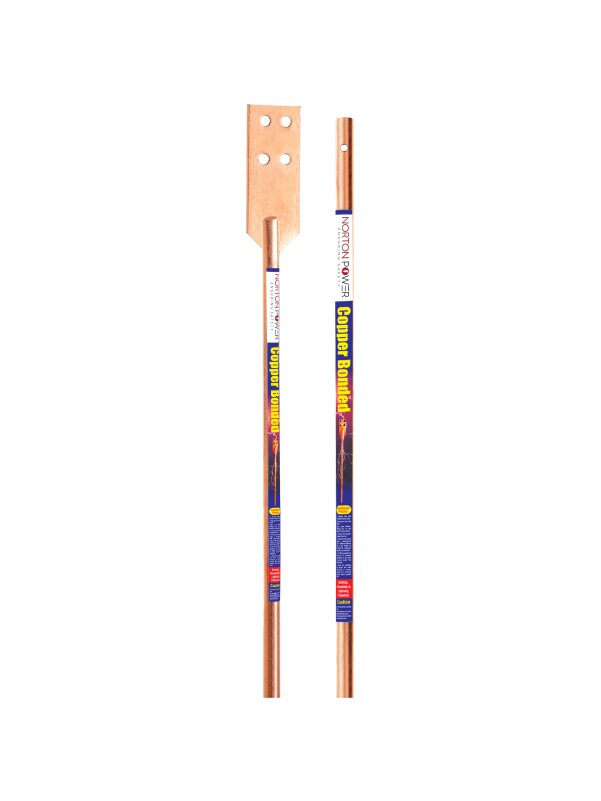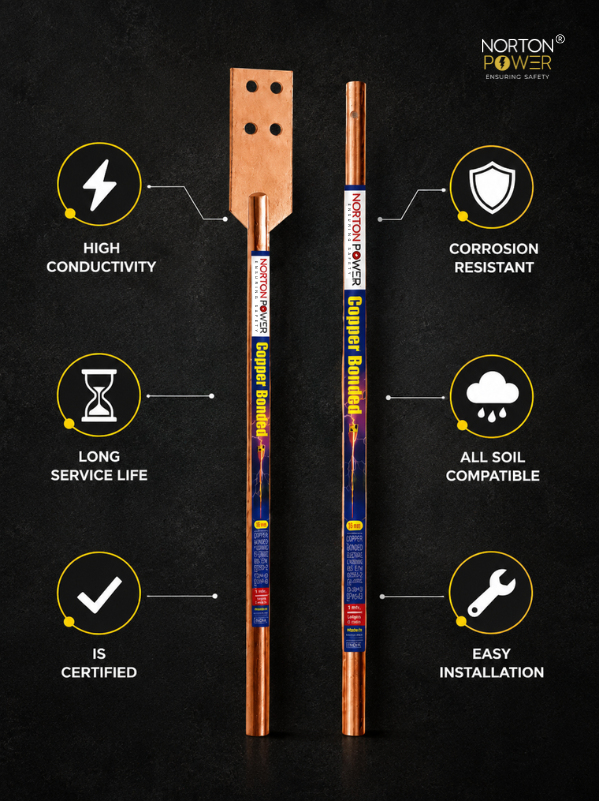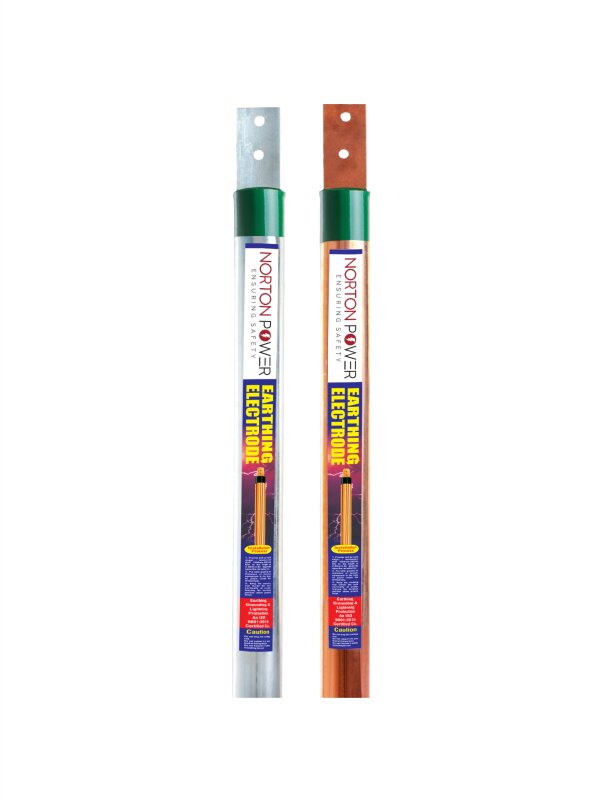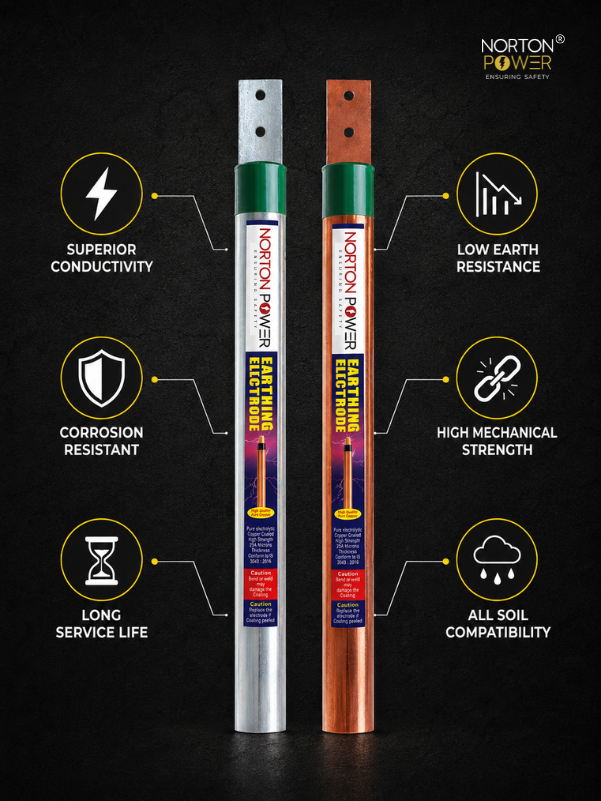
Most copper-bonded earthing rods on Indian B2B catalogues today are listed at 100 microns. UL 467, the international standard that grounds substations from Texas to Bavaria, requires 250 microns. The 2.5x difference isn’t a marketing flourish — it’s the threshold where the rod’s lifetime stops being a coin toss and starts being a four-decade engineering bet.
This piece walks through why the standard sits at 250 µm, what the field studies actually found, and how to think about the cost trade-off when your tender allows either tier.
1. What "250 microns of copper" actually means
A copper-bonded rod is a high-tensile steel core sleeved in a metallurgically bonded copper jacket. The number — 50, 100, 150, 250 microns — is the radial thickness of the copper jacket, not the rod diameter.
For context: a sheet of standard A4 paper is roughly 100 microns thick. A 250 µm copper layer is therefore about 2.5 paper-thicknesses of pure copper wrapped around the entire surface of the rod, bonded so completely that the rod can be driven 3 meters into hard subsoil without the jacket peeling, cracking, or de-laminating.
The bonding process matters as much as the thickness. UL 467 specifies an electroplating route that produces a molecular bond between copper and steel — not a hot-dip coating that sits as a separate layer.
2. The corrosion math behind the number
Copper corrodes in soil at roughly 0.5 to 5 microns per year, depending on soil chemistry, moisture, presence of sulphides, and stray DC currents. The wide range is the catch: a rod buried in benign clay loam might lose 0.5 µm/year, while the same rod in coastal saline soil near a DC traction system might lose 3-4 µm/year.
Standards bodies pick a coating thickness that protects against the worst-case soil multiplied by the expected service life. The arithmetic for UL 467’s 250 µm is:
| Coating thickness | Worst-case life (3 µm/yr soil) |
|---|---|
| 50 µm | ~17 years before steel exposure |
| 100 µm | ~33 years before steel exposure |
| 150 µm | ~50 years before steel exposure |
| 250 µm | ~83 years before steel exposure |
Once the copper is gone, the steel core corrodes rapidly (steel rusts at 50-200 µm/year in moist soil), and the rod stops being an effective earthing conductor within a year or two. The 250 µm tier exists so the engineer who specifies it can sign off knowing the rod will outlast the building it grounds, even under bad soil conditions.
3. Field evidence: GI rods at 10 years vs copper-bonded at 40
The strongest argument for UL 467 thickness is not the lab math — it’s the excavations. Two field studies are routinely cited:
- BPL India’s 2004 retrofit of a 1993 substation: galvanised-iron rods extracted after 11 years showed > 80% surface degradation; copper-bonded rods installed the same year showed < 5% surface degradation, with measured resistance unchanged from commissioning.
- A 2018 Maharashtra State Electricity Transmission Company report on 25-year-old earth pits found that pit covers with 250 µm copper-bonded rods underneath had resistance values within 10% of original commissioning values; pits with 50-100 µm rods had drifted by 80-120%.
These are not controlled lab studies — they are after-the-fact excavations. But the consistency of the result is what matters: thinner coatings drift; thicker coatings hold. The 250 µm tier is where the curve flattens.
4. When does specifying less than 250 µm make sense?
There are legitimate reasons to step down:
- Temporary or transitional installations (commissioning, test labs, short-term industrial setups) where the rod will be lifted within 5-10 years.
- Indoor or sheltered environments (computer-room equipotential bonding, generator skid earthing inside enclosed buildings) where soil contact is minimal.
- Benign-soil regions (well-drained clay loam without chemical contamination or stray DC) where the 0.5 µm/year corrosion rate dominates — a 100 µm rod will last 50+ years here too.
- Budget-driven distribution-level installations where IS 3043 minimum compliance is enough and UL 467 is not in scope.
Specifying down is fine when the soil and use-case justify it. The argument for the 250 µm tier is for the cases that often do not get those considerations — solar plants on saline coastal land, telecom towers in agricultural fields with fertiliser run-off, petrochemical sites near brackish water tables.
5. The cost-per-year-of-service argument
A 100 µm copper-bonded rod sells in the Indian market at roughly 60-65% of the price of a 250 µm rod. Cheaper, yes. But the lifetime ratio is closer to 1:2.5. Replacing the rod once over the building’s life — excavation, recommissioning, pit re-treatment, downtime — costs more than the difference in original spec.
This is why infrastructure tenders (DDA, NTPC, large solar IPPs) increasingly mandate UL 467 250 µm as the floor: it removes the maintenance-cycle risk from the operational budget. For everything else, the spec should be a conscious choice, not a default.
6. What to ask when you buy a copper-bonded rod
- What is the radial copper thickness in microns? (“Copper bonded” alone tells you nothing.)
- Is the bond electroplated (UL 467 method) or hot-dipped? Electroplating is correct.
- Is there a third-party test certificate from CPRI or equivalent for fault-current carrying capacity?
- What is the copper purity? UL 467 specifies 99.9% electrolytic copper minimum.
- Can the supplier produce a coupling kit so multiple rods can be joined for deep installations beyond 3 m?
If the answer to question 1 is anything below 100 µm and the use-case is permanent infrastructure, walk away. If the answer is 250 µm and the rest of the questions check out, you have a rod that will outlast every other component in the earth pit.