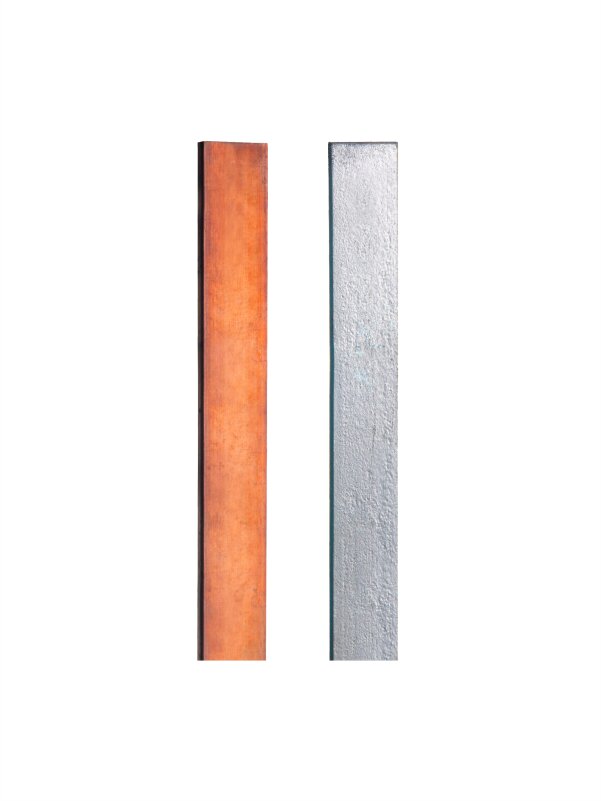
The current-carrying capacity of an earthing strip is a fault rating, not a continuous one: the strip has to carry the fault current for the fraction of a second it takes protection to clear, without overheating. It is set by the cross-section and the material. For a GI strip of 25 x 3 mm the one-second withstand is about 6 kA; for 50 x 6 mm it is about 24 kA.
1. Why it is a fault rating, not continuous amps
An earth conductor normally carries no current. It only has to survive the fault until the breaker trips, so it is rated for a short-time fault current for a stated clearing time (commonly one second). IS 3043 and IEEE 80 use the adiabatic rule: cross-section equals fault current times the square root of the clearing time, divided by a material factor (about 80 for galvanised steel).
2. Indicative GI strip ratings (1 second)
| GI strip size | Approx. fault current for 1 s |
|---|---|
| 25 x 3 mm | About 6 kA |
| 25 x 6 mm | About 12 kA |
| 32 x 6 mm | About 15 kA |
| 40 x 6 mm | About 19 kA |
| 50 x 6 mm | About 24 kA |
| 50 x 10 mm | About 40 kA |
| 65 x 10 mm | About 52 kA |
3. Longer clearing time means a bigger strip
The rating scales with the square root of time. A strip good for a current for one second carries only about 70 percent of it for two seconds, and about 45 percent for five seconds. On slow-clearing systems, size up.